



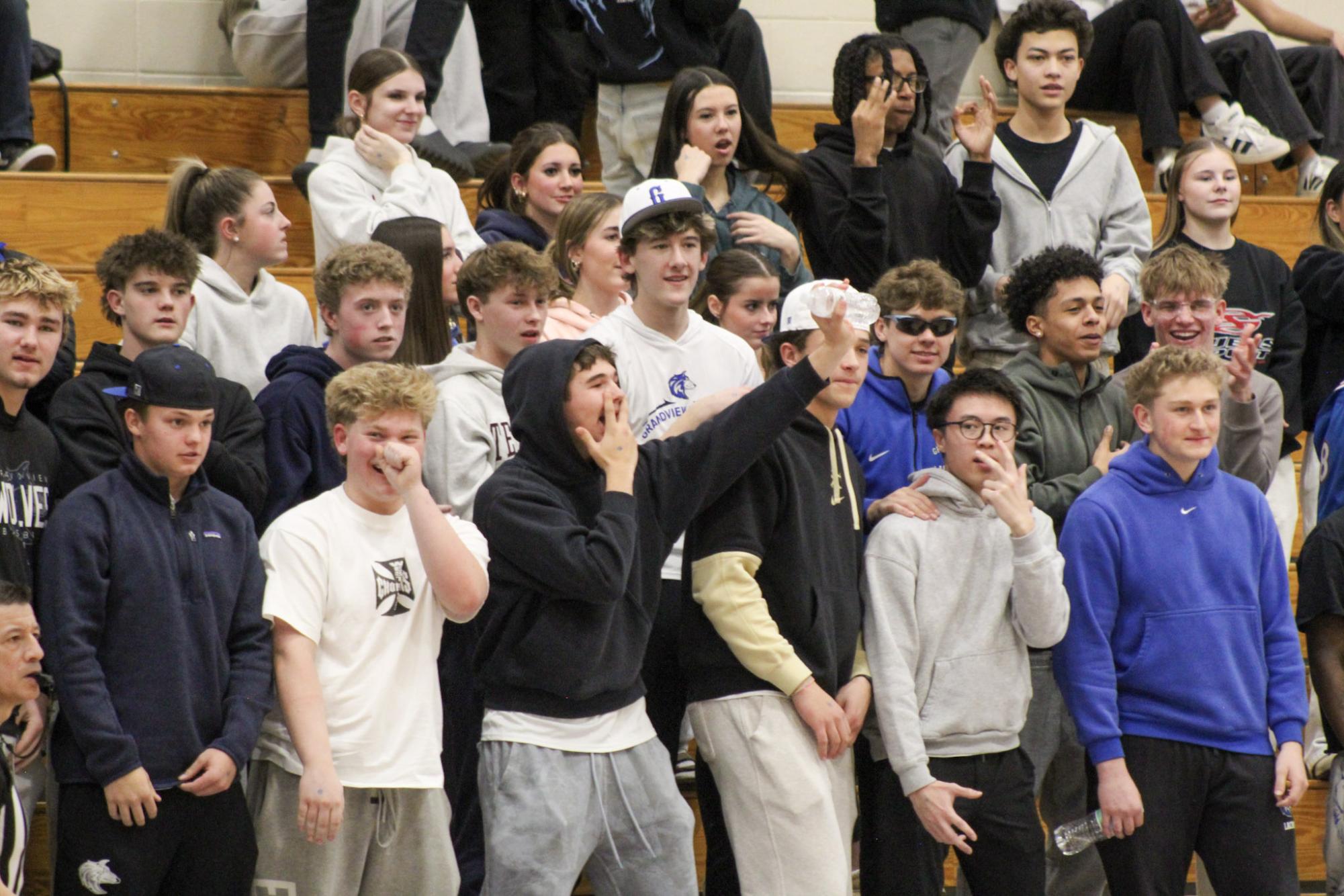
On January 28th, Grandview’s Basketball team faced Mullen High School. Despite the importance of the game, the crowd was initially silent. The atmosphere seemed bleak as the Grandview boys’ team was down by twelve in the first half.
“It wasn’t one of our bigger crowds, so the energy wasn’t there as much [at first]. The game wasn’t jumping,” Vincent Parsons (11) said.
However, it all changed when just 20 students arrived late to the student section. The atmosphere immediately changed. Even though the student section was still small, the voices were big. The gym echoed with cheers for the Wolves.
“When opponents are about to shoot the free throws- if you scream or do something loud- you throw them off. That’s just an extra point that they don’t deserve. [Chants] also help on defense, like ‘D Up’. Different chants just help [our players] get more locked in and unlock the opposing team,” Jason Dix (10), a student that was in the crowd said.
During the game, the noise of the crowd disrupted the opponent’s focus and boosted the confidence of Grandview’s players. The game was suspenseful until the end, with a score of 51-49, Grandview ultimately pulling off the win.
“Showing up and making noise is very important because it makes the players feel motivated to perform better. It sorta changes their mindset to ‘Oh, I have to stand out to these people. I have to show out. I have to do well because I need to show all these people what I can do and what I’m capable of,’” Dix said.
Beyond motivating the players, students stress that school spirit reflects a broader sense of responsibility and pride within the schools’ community. They encourage their peers to come out and support.
“If you want to represent Grandview [come] support every team to make us stronger,” Kaleb Yohannes (11) said.
In addition to school pride, some students believe that strong communication and consistent promotion and attendance from other students play a significant role in increasing attendance at school events. They argue that keeping students informed about upcoming games and activities can help build a more supportive and engaged community for the school.
“If we get the games out more, such as posting flyers, telling everyone weekly, [or] making announcements, more students would show up,” Dix said.
The increase in student participation isn’t just about boosting attendance numbers but about shaping the overall game day experience, for both players and spectators.
“You’re [feeling] everything in real time and a part of everything. Your voice really matters in games; it makes a big difference,” Yohannes said.


![The Stone Age Starts with the Schools [OPINION]](https://ghschronicle.com/wp-content/uploads/2026/04/iranphoto-1-900x1200.jpg)


![Grandview Suffers Defeat to Rock Canyon 66-52 [PHOTO GALLERY]](https://ghschronicle.com/wp-content/uploads/2026/03/3-Swanson_Boys_BasketballvsRockCanyon369A7271-1200x800.jpg)