



From December until August, there sits a dusty, cluttered space beneath the stage, seldom seeing light, people, or fresh air. It holds old planks, hardware, and miscellaneous junk. But for very few weeks every year, it comes alive; music fills the air, notes soar, and harmonies intertwine. This is the space we call the pit. And it’s the people who gather here, in the weeks before the fall musical, who really bring it to life.
“I love working alongside them because they are always really passionate about the music in the show, and it ends up sounding really good alongside the actors,” Osa Darlington (10), assistant stage manager, said.
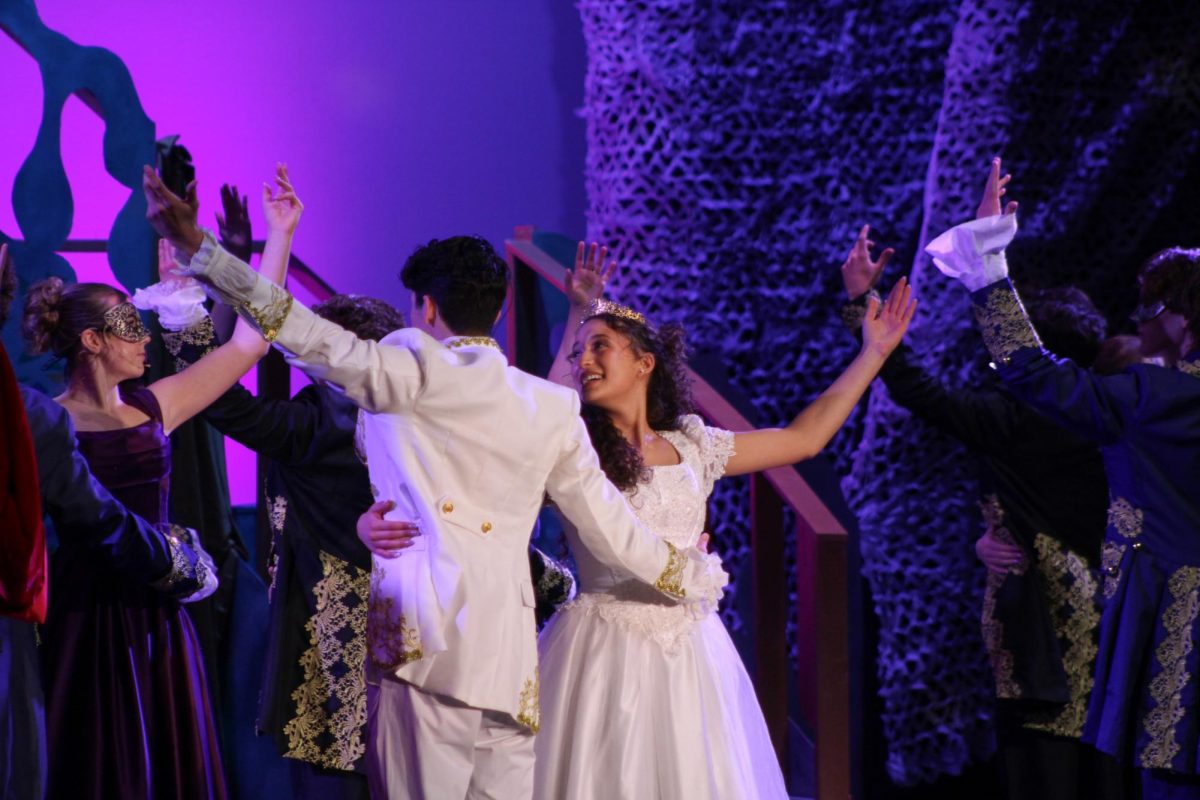
This year, Grandview’s most talented and experienced musicians will gather beneath the stage to play for the 2025 musical, Cinderella. The pit is considered one of the most difficult musical endeavors that can be undertaken by either conductors or students.
“It’s quite competitive to get in,” Royce Ehrle, pit conductor, said. “Lots of people want to do it, but the music is so hard that even juniors and seniors are challenged.”
Due to this difficulty, pit is typically reserved for upperclassmen and more experienced musicians.
“I’ve auditioned the past 2 years and didn’t get in either time,” Benjamin Tobin (11), trumpet player, said. “It usually goes to the oldest senior trumpets because they have the most experience, and they’ve been waiting the longest for the opportunity.”
But this isn’t any ordinary orchestra. Inside the pit, 26 students play a mix of unique instruments, including string instruments, brass and woodwind instruments, percussion, a harp, and even a keyboard. This is necessary for the wide variety of music required for Cinderella and other musicals.
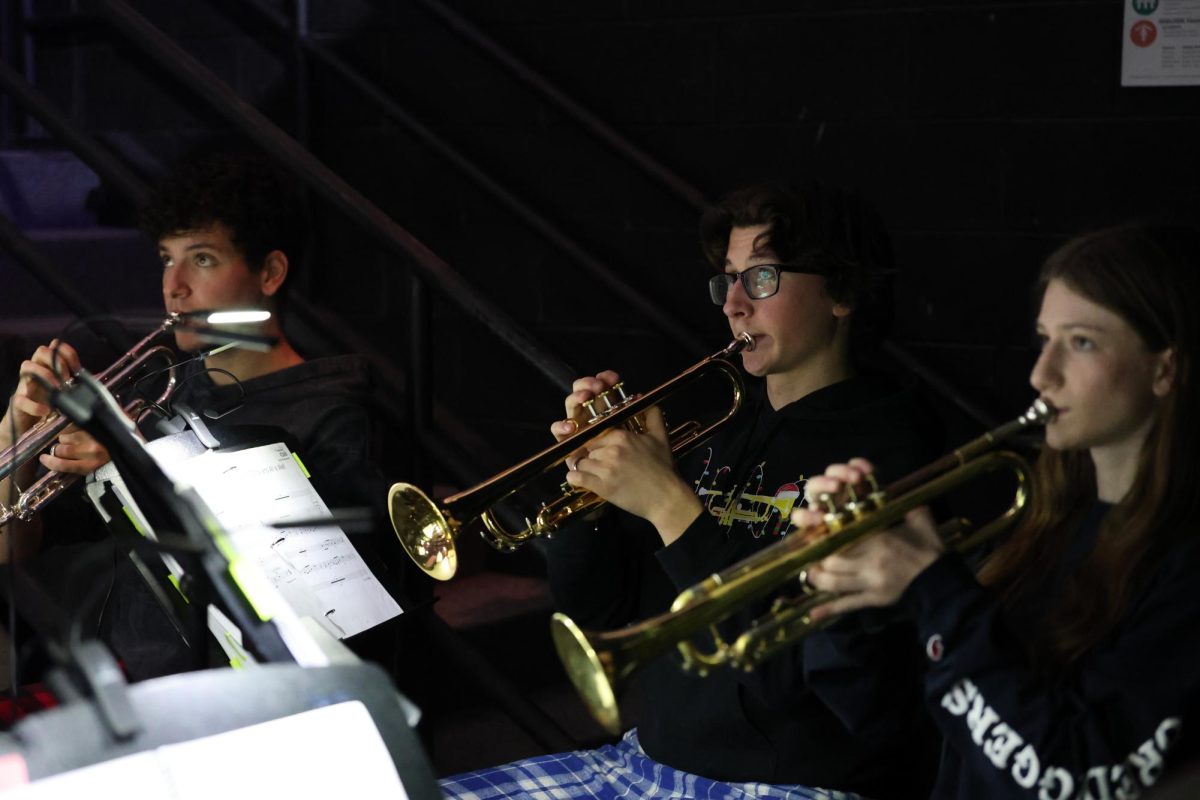
“The music is more challenging than a lot of the music that I get to play in band,” Lucas Engdahl (12), French horn player, said.
As the orchestra nears the show, their rehearsals become longer and more rigorous. For a show that is nearly 2.5 hours long, like Cinderella, practice is the best way for the musicians to hone their skills and build up stamina for the big opening night, November 14th.
“This week, we went to 6:30 every day after school, and [at the time of interviewing] we’re at ‘Longest Day’, which is about 7 hours of rehearsal,” Tobin said.
Contrary to popular belief, music isn’t the only thing the pit is responsible for during the show. They also produce whatever sound effects the script necessitates.
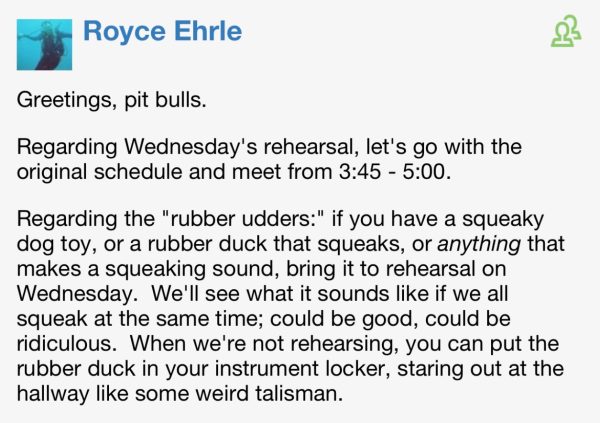
For example, the pit uses dog toys and rubber ducks to produce a squeaky sound for the mice in the show. And this is just one odd sound effect expected of the musicians.
“For one of the songs, I have to do a ‘flutter tongue’ in order to sound like a fireball,” Gabriella Menendez (11), French horn player, said. “You basically have to roll your R’s into your horn on a sustained E-flat.”
Another piece about pit that makes it trickier than a normal orchestra is that they have towork alongside the actors, rather than just by themselves. The conductor acts as the median between the activities on stage and the pit. They have a copy of the script, and while conducting, they search for line cues to determine the lengths of vamps and when to play.
“It’s very challenging,” Ehrle said. “It’s more than just conducting an orchestra or more than just conducting a band. It’s the actors and the singers, and the orchestra has to be coordinated with what’s going on on stage. It’s a lot of balls to juggle.”
The expertise and hard work of the pit and its conductor does not go unnoticed by the actors.
“I love acting alongside live music and seeing them in the pit,” Lyla Hanson (12), who plays the Fairy Godmother, said.
However, pit faces a challenge similar to the tech crew and other behind-the-scenes show members, sometimes even more so; their work often goes unnoticed by audience members. A lot of this is due to the fact that the musicians are so out-of-sight as compared to the actors and even the tech crew.
“The audience can’t see the orchestra, so they don’t think about the orchestra,” Ehrle said.
Even through their lack of audience recognition, the pit orchestra remains an experienced and united group that represents some of the best of the pack. Together with a talented group of actors and tech crew, the theater productions at Grandview are an amalgamation of the hard work and expertise of many students.
“I do pit because I love being a musician,” Menendez said. “I get to be a part of something bigger than myself. And I think that’s pretty cool.”




![The Stone Age Starts with the Schools [OPINION]](https://ghschronicle.com/wp-content/uploads/2026/04/iranphoto-1-900x1200.jpg)



![Unified Theatre Stars in Their Production of Shrek [Photo Gallery]](https://ghschronicle.com/wp-content/uploads/2026/04/shrekfischer_7933-1200x800.jpg)
T. Peterson • Nov 15, 2025 at 9:46 am
The pit did an awesome job at the Friday 11/14 performance of Cinderella. They sounded so professional and added so much to the production.
MaryAnn Beatty • Nov 14, 2025 at 9:09 am
How special to read a tribute to an under-appreciated group of students. As a proud grandmother of one of the pit orchestra players, I look forward to experiencing the results of their “hidden efforts” during the production of Cinderella.