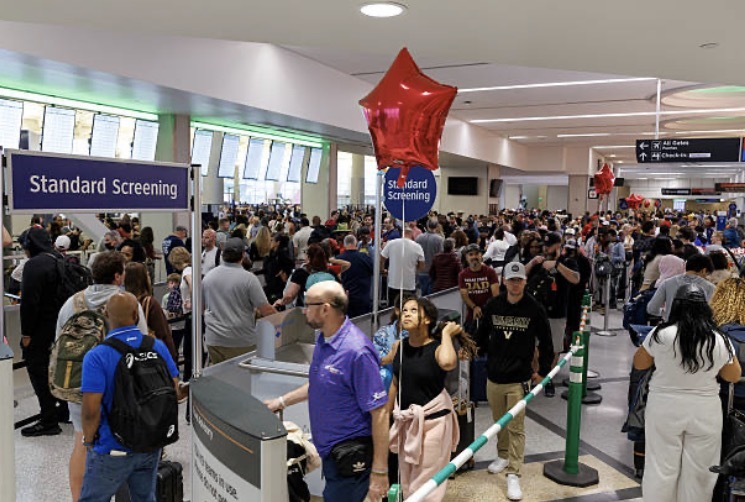
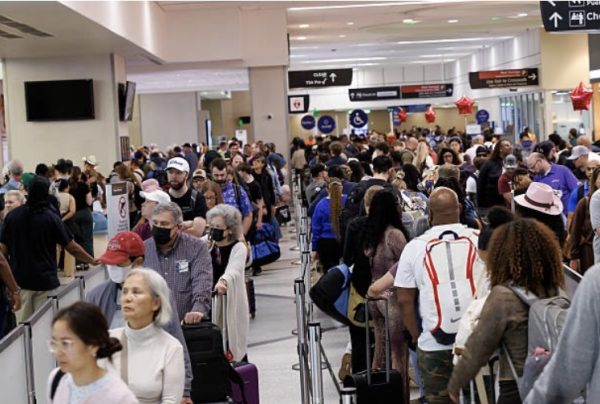
Throughout the United States, airport wait times have nearly quadrupled due to a combination of government funding disputes, high travel demand, and staffing shortages in the Transportation Security Administration (TSA). Many commuters have reported flight cancellations, delays, and up to four-hour waits in security lines.
“Multiple airports are experiencing days where 40 to 50% of their staff are calling out because they simply cannot afford to report to work,” Ha Nguyen McNeill (Acting TSA Administrator) said. “This has led to the highest wait times in TSA history, with some wait times greater than 4.5 hours.”
According to some passengers, airports have become hectic and inconvenient in the wake of the shutdown. Airlines such as Delta, United, and Southwest have faced significant flight postponements and disruptions. This interference has resulted in a stressful environment for both travellers and staff alike.
“When I went [to the airport], it seemed pretty messy from my perspective,” Valerie Milligan (10) said. “They sent us back twice while we were in line because they couldn’t scan our boarding passes. And a lot of the planes seemed to be very jumbled. We were sitting on the plane for an hour after we landed because another plane was in our airstrip, so we couldn’t leave. It was very confusing—it seemed like there weren’t enough people working.”
An estimated 90% of the 260,000 Department of Homeland Security (DHS) employees have been forced to work or are furloughed. Approximately 61,000 TSA employees working without pay have missed over $1 billion in paychecks. Whilst some back pay is being processed, workers are still missing 20-40 hours of pay, leaving them unable to afford necessities. Immigration and Customs Enforcement (ICE) has been assigned to help TSA during its staffing shortages—though some speculate that its presence is more harmful than helpful. Over 500 TSA workers have quit since the shutdown began, and thousands more have missed their shifts. Call-out rates increased to 11% nationwide.
“During a shutdown, the ability to pay for rent, bills, groceries, childcare, and gas just to get to work becomes very challenging, leading to increased unscheduled absences as a shutdown progresses,” McNeill said. “Higher call-outs can result in longer wait times at checkpoints, leading to missed or delayed flights, which have a cascading negative impact on the American economy.”
Due to the shutdown, multiple TSA officers have refused to show up to work—largely because they aren’t being paid. Workers often rely on donations of food, diapers, and gift cards for gas or groceries to cope with missing paychecks.
“The airport opened a food pantry with canned foods, basic vegetables, and other boxed food items,” Alan Quillinan (TSA Officer) said. “They also had diapers, soap, toilet paper and other basic grocery items. We were allowed to go every day during our shift and could take 12 items per day. Passengers also donated gift cards. Management collected them and handed them out every few days. I received around $250 in gift cards to King Soopers and Walmart. We also received 50% off at a few different restaurants at the airport.”
These efforts are voluntary gestures of support from the public, nonprofits, and airport communities. Organizations such as World Central Kitchen, Operation Food Search, and Feeding San Diego have stepped up to help donate meals at airports. Likewise, airport dining vendors have given discounts and covered entire meals, as stated by Perry Cooper (Airport Spokesperson).
“You know a lot of these people,” Cooper said. “And then to realize that some of these folks are here and they’re not getting paid, [it] really tugs at your heart to think [about] a way that we can help.”
The government entered a partial shutdown on February 14, 2026, specifically affecting only the DHS. Lasting for over 60 days, this shutdown is the longest in history. Congress failed to pass spending bills due to disputes over funding for immigration and border security, which Senate Democrats argue need major reform. They expressed their need to restrict roving patrols, tighten parameters on warrants for searches and arrests, toughen use-of-force policies, and require ICE agents to wear body cameras and remove their masks. Typically, most ICE and CBP employees would work through a government shutdown without payment. In the previous shutdown, though, ICE and Customs and Border Protection (CBP) were still paid—further fueling Democrats’ battle to mend immigration financing.
“They [the Trump administration] have got to get serious,” Chuck Schumer (Senate Minority Leader D-NY) said. “The key issues of warrants when you bust in someone’s house, the key issue of identity of police, no masks, they haven’t budged on those. They’ve got to get serious.”
On March 30th, President Donald Trump issued an executive order directing the DHS to use available funds with a “reasonable and logical nexus” to pay TSA. This money came from an estimated $10 billion from last year’s One Big Beautiful Bill Act. The order provided TSA officers with a portion of their back pay; however, future payments are unguaranteed.
“I hereby direct the Secretary of Homeland Security, in coordination with the Director of the Office of Management and Budget, to use funds that have a reasonable and logical nexus to TSA operations to provide TSA employees with the compensation and benefits that would have accrued to them if not for the Democrat-led DHS shutdown, consistent with applicable law,” Trump said.
It is unclear when the shutdown will end, with prediction markets suggesting it could last for over 80 days, potentially leading into May. While a Senate-passed, bipartisan deal exists, it is currently stalled by the House Freedom Caucus (HFC) faction opposing it.
“The only thing we’re going to support is adding that funding into the bill, adding voter ID, sending it back to the Senate, making them come back in and do their work,” Andy Harris (HFC Chair R-MD) said. “The bottom line is, this deal is bad for America.”
To better manage airport lines and call-outs, Quillinan recommended increasing employee motivation to come to work. After the October shutdown was resolved, officers received a bonus for showing up to work daily, despite not being paid. Kristi Noem (former DHS Secretary) announced this bonus for select TSA workers who demonstrated “exemplary service” during the 43 days.
“[I would suggest] offering incentives to officers who show up every day,” Quillinan said. “Last shutdown, officers with perfect attendance received a $10,000 bonus, but no one knew about it until after the shutdown was over. If officers knew there was a guaranteed incentive, there wouldn’t be as many call-offs.”


![The Stone Age Starts with the Schools [OPINION]](https://ghschronicle.com/wp-content/uploads/2026/04/iranphoto-1-900x1200.jpg)