


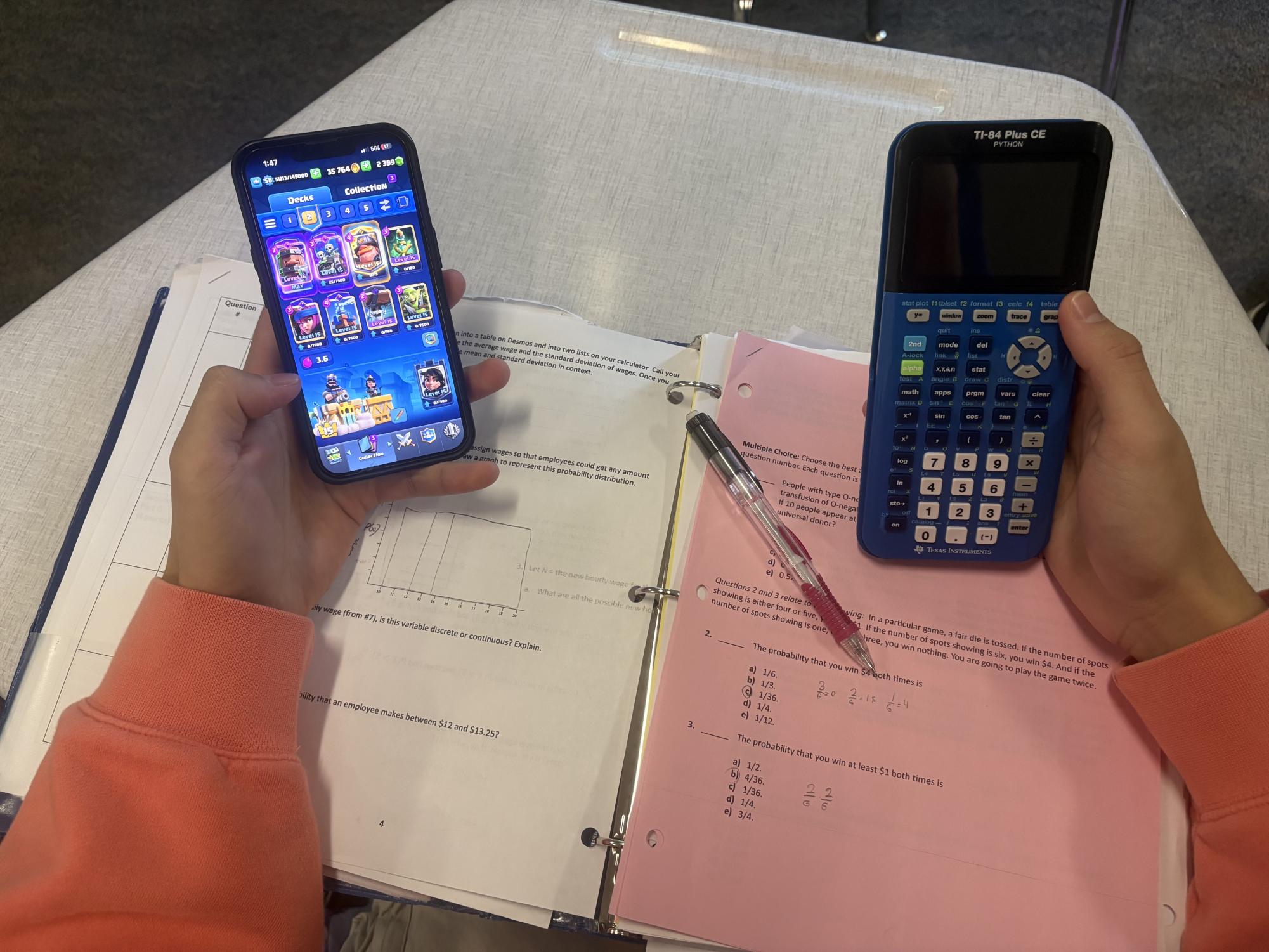
For the past several years, a type of competition has filled the halls and classes inside of Grandview: the fast-paced mobile game, Clash Royale. This game has gone from a casual distraction or time-filler to something you can’t put down, with an almost addictive grip on its target audience- teenage boys.
“It feels like chess but with way more pressure,” Senior Linkin Alisasis said. “You’re always thinking a couple moves ahead, but everything is happening in real time, so it gets addicting really fast.”
Clash royale is a cartoon-like game where the objective is to destroy your opponent’s tower while defending your own by summoning troops at a certain elixir cost. Players try to predict what their opponent is going to do next. Many mobile games rely on luck or time to improve, while Clash Royale relies on planning and strategy. Because of this, players get a fulfilling dopamine rush.
“People think it’s just another phone game, but at higher levels you really have to study the meta, [the most effective tactic available], and think about your opponent’s rotation,” Senior Santiago Zerega said. “When I peaked at top 10,000 players I would track every card they played in my head during the game. It’s like speed chess with towers.”
For some players, the depth and opportunity in this game is what keeps them opening the app again and again, making it hard to walk away or use their time for more productive things, such as schoolwork.
“I deleted it for a few months because I was spending way too much time grinding ladder,” Zerega said. “When I was trying to push higher up in the top 10,000, I was spending on average six to nine hours a day.”
The games only last a few minutes, which is very convenient for teens in our school for teens to play just “one more game,” before starting their work. The mix of how different strategies are in these short games, give repetitive dopamine hits, which turns that “one game” into hours of game time.
“A lot of the time I will tell myself, ‘It’s only three minutes,’ and then suddenly an hour is gone,” Alisasis said. “Because winning it’s so dependent on the mistakes that you make, you want to fix these mistakes, so you keep playing until you get that perfect match.”
Some players think that Clash Royale is “pay to win.” While the game is free to download, spending money lets you speed up card upgrades and unlock more powerful cards quicker than playing for free.
“If someone drops money on the game, they can max out cards way quicker than you,” Zerega said. “You can outplay them sometimes, but if their cards are way higher level, it’s like playing chess when the other person gets an extra queen.”
Despite this, many students keep playing Clash Royale because of those competitive mental challenges they can’t get from other mobile games. Even with the pay-to-win aspect of the game, all the other aspects still pull them back in.
“It trains your brain to think ahead. You’re planning openings, predicting counters, and adjusting mid-game. It’s like practicing chess just with tiny knights and goblins instead of wooden pieces,” Alisasis said.
As Clash Royale continues to grow in popularity, its addictive nature makes it hard for students to find a balance, even when they try to treat it like a puzzle or a game of chess rather than letting it control their schedules. For players like Zerega, quitting and coming back to the game is part of the cycle. The highs are very high, and the lows give the same emotional effect as losing while gambling.
“As soon as you start thinking of it like chess or a big puzzle, the wins feel insanely good, and the losses hit way harder than they should,” Alisasis said. “It’s like your brain keeps chasing that next high, so even when you know it’s bad for your focus, you still press play again.”
Overall, Clash Royale can have a positive impact on our brains, making you think strategically and at a quick pace, knowing that if you make one wrong move, you will lose. But the negative effects outweigh the good. The addictive part of this game can cause teens in this school to lose money because they feel like they need to pay to win. On top of that, it can ruin teens’ time management, leading to things such as not doing classwork when they’re given time to do it.
“Clash Royale starts as something you do for fun, but if you’re not careful, it becomes something that controls your time, your mood, and even your sleep,” Zerega said. “It’s crazy how a game on your phone can feel harmless and still quietly wreck your focus and your life if you let it.”


![The Stone Age Starts with the Schools [OPINION]](https://ghschronicle.com/wp-content/uploads/2026/04/iranphoto-1-900x1200.jpg)





![Unified Theatre Stars in Their Production of Shrek [Photo Gallery]](https://ghschronicle.com/wp-content/uploads/2026/04/shrekfischer_7933-1200x800.jpg)
Lukas • Dec 4, 2025 at 6:53 pm
“i swear i’m not addicted” said all clash players
Michael • Dec 8, 2025 at 10:25 am
*proceeds to waste 8 hours getting a card*